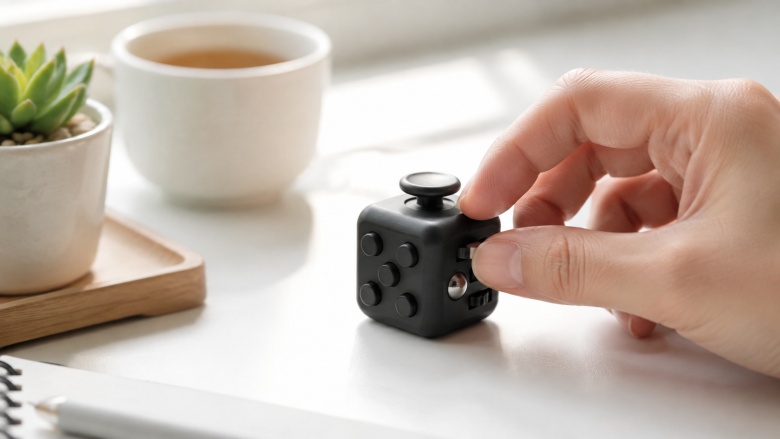
The Fidget Cube Is Not Just a Toy - It's a Mindfulness Anchor
When I first got a fidget cube, I treated it like a nervous habit - clicking the buttons while scrolling through my phone, spinning the dial during meetings. It helped a little, but honestly, it felt more like a distraction than stress relief. Then I made a mistake: I expected the cube to do the work alone. I soon learned that the cube is not a magic stress eraser. It is a tool - and like any tool, it works only when you use it with intention.
The real power of a fidget cube lies in its ability to anchor your attention to the present moment. Instead of letting your mind spiral into 'what if' scenarios, you can use the cube's tactile feedback to ground yourself in the here and now. That is the difference between mindless fidgeting and mindful stress relief.
In this guide, I'll share five specific techniques that combine fidget cube actions with proven stress-reduction methods like grounding, breathing, and sensory reset. You'll learn exactly how to use the cube to calm your nervous system, not just occupy your hands.
Why a Fidget Cube Can Help with Stress (and Why It Might Not)
Does a fidget cube help with stress? The honest answer is: it depends on how you use it. Research suggests that repetitive tactile stimulation can lower cortisol levels and improve focus for some people. A 2017 study published in the Journal of Attention Disorders found that fidget spinners (a similar tool) reduced self-reported stress and anxiety in a small sample of college students, but the effect was modest and not universal.
The cube works best when it serves as a sensory anchor - a physical focus point that keeps your mind from drifting into stressful thoughts. When you press a button or slide a switch, you give your brain a simple, non-threatening task to process. This can interrupt the cycle of rumination that fuels stress.
But here's the thing nobody tells you: if you use the cube while scrolling social media or watching TV, you're just fidgeting, not relieving stress. The cube only helps when you pair it with deliberate attention. That's why I call it a mindfulness anchor, not a distraction.
Most people don't realize that the cube's effectiveness also depends on matching the action to your current state. For high-energy anxiety, you need a fast, clicking action. For low-energy overwhelm, you need a slow, sliding motion. I'll cover this in the techniques below.
Technique 1: The 5-4-3-2-1 Grounding Exercise with Your Fidget Cube
Grounding techniques are a staple of anxiety management. The 5-4-3-2-1 method uses your five senses to pull you out of a panic spiral. Here's how to adapt it with your cube:
Step 1: Hold the cube in your non-dominant hand. Take a deep breath in through your nose, out through your mouth.
Step 2: Look around and name 5 things you can see. As you name each one, press a different button or roll the dial. This links the visual recognition with tactile feedback.
Step 3: Next, find 4 things you can touch. Run your fingers over the cube's textures - the bumpy grip, the smooth face, the indented buttons. Notice the temperature and pressure.
Step 4: Now, identify 3 things you can hear. As you listen, slide the cube back and forth slowly. The sound of the slider can become a soft metronome for your attention.
Step 5: Find 2 things you can smell. If you're indoors, you might smell coffee or fresh air from a window. With each smell, click the cube twice - a quick, deliberate pair of clicks.
Step 6: Finally, name 1 thing you can taste. Take a sip of water or just notice the taste in your mouth. Press the cube's middle button firmly and hold for five seconds. Release.
This whole exercise takes about two minutes. I've used it in the middle of a stressful workday, and it works because it forces your brain to process information from multiple senses simultaneously - which leaves less room for anxious thoughts.
Technique 2: Cube-Paired Breathing for Deep Calm
Breathing exercises are the gold standard for activating the parasympathetic nervous system - the 'rest and digest' mode. The problem is that most people find it hard to focus on their breath alone. The cube gives your hands something to do while you breathe, making the practice feel less awkward.
Here's a simple 4-7-8 breathing pattern, adapted for the cube:
- Inhale for 4 seconds: Slowly rotate the dial clockwise. The smooth, continuous motion mirrors the inhale.
- Hold for 7 seconds: Press and hold the middle button. The resistance of the click keeps you engaged.
- Exhale for 8 seconds: Rotate the dial counterclockwise. Make the rotation slower than the inhale, matching the longer exhale.
Repeat this cycle for five rounds. If you don't have a dial, you can use the roller or the slide. The key is to sync the movement with the breath. I've found that the tactile rhythm helps people who get distracted by counting - you don't need to count breaths, just follow the motion.
One thing that can go wrong: if you try to force the breath to match the cube instead of the other way around, you'll feel more stressed. Start with the cube movement, then let the breath follow naturally. After a few rounds, you can even drop the cube and just breathe - the cube was your training wheels.
Technique 3: Sensory Reset Breaks (for Work or Study)
Stress builds up gradually during the day. You don't always need a 10-minute meditation; sometimes a 60-second sensory reset is enough to lower your stress level. This is where the cube shines as a portable tool.
Set a timer on your phone for every 45 minutes. When it goes off, take a sensory reset break:
- Stop what you're doing. Put your hands on the cube.
- Close your eyes. For 10 seconds, just feel the cube's texture - the bumps, the grooves, the edges. Don't manipulate it, just hold it.
- Open your eyes. Choose one action: click the buttons five times, slide the switch back and forth three times, or spin the dial for 15 seconds.
- Take three deep breaths. Inhale through your nose, exhale through your mouth.
- Set the cube down and return to your task.
This break works because it interrupts the stress response cycle before it peaks. It's like a 'reset button' for your nervous system. In my experience, the cube is especially effective during long stretches of screen time, when your eyes and brain need a break from visual input but you can't leave your desk.
I also use this technique before meals. As we covered in our guide to mindful eating without stress, taking a moment to reset before eating can improve digestion and reduce stress-related overeating. The cube is a great way to transition from work mode to mealtime.
Technique 4: The 'Cube as a Focal Point' for Mindfulness Meditation
If you've tried meditation and found it difficult to sit still, the cube can be a physical focal point. This is a more advanced technique that transforms the cube into a meditation object, similar to a candle flame or a mantra.
Find a comfortable seated position. Hold the cube in your lap or on your thigh. Choose one side - for example, the side with five buttons. Your task is to press each button in a sequence, slowly, with full attention. Notice the resistance of each button, the sound it makes, the exact moment it clicks.
When your mind wanders (and it will), gently bring your attention back to the buttons. This is the same as noticing a wandering thought in meditation and returning to the breath. The cube gives you a concrete anchor that's easier to grasp than the breath, especially for beginners.
Start with 3 minutes. Gradually increase to 10 minutes if you like. I've found that this practice builds mindfulness muscle - the ability to notice when you're distracted and refocus. Over time, you'll be able to apply that skill in stressful situations without the cube.
Technique 5: The 'Cube Toggle' for Emotional Regulation
Stress often comes with emotional spikes - anger, frustration, or anxiety. The cube can help you regulate these emotions by giving you a physical way to 'toggle' between states.
Here's the idea: when you feel a strong emotion, you don't need to suppress it. You can use the cube as a way to channel the energy. For high-arousal emotions like anger or panic, use fast clicking actions - press the buttons rapidly for 30 seconds. This releases physical tension. Then, switch to slow, deliberate slides or rotations for another 30 seconds. This signals to your brain that the danger has passed.
This technique is based on the principle of 'emotional granularity' - the ability to label and differentiate emotions. By pairing specific cube actions with emotional states, you're teaching your brain to associate the action with the feeling. Over time, you can use the cube to shift your state on purpose.
One caveat: this is not a substitute for professional help if you have chronic anxiety or depression. The cube is a coping tool, not a treatment. If stress is interfering with your daily life, talk to a mental health professional.
What Research Says About Fidget Toys and Stress
Do fidget toys actually relieve stress? The scientific evidence is mixed. A 2018 review in Current Opinion in Psychology noted that while fidget toys are popular for self-regulation, there is little high-quality research on their effectiveness. However, studies on sensory stimulation, like the work of the National Institute of Mental Health, show that tactile stimulation can reduce cortisol and anxiety in certain contexts.
The key is that fidget toys work best when they are part of a broader stress management strategy. They are not a magic bullet. If you use them mindlessly, they may actually increase distraction. But when used with intention - as I've described above - they can be a valuable tool.
I've seen this in my own life. The cube helped me get through a particularly stressful project deadline, but only after I started using it with breathing and grounding. Before that, it was just a piece of plastic in my pocket.
Five Tips for Reducing Stress (That Include the Cube)
Let's step back and answer the broader question: what are five tips for reducing stress? These are the core strategies I recommend to friends and colleagues, with the cube as a supporting tool.
- 1. Use the cube as a mindfulness anchor. When you feel stress rising, take 60 seconds to do the 5-4-3-2-1 exercise or cube-paired breathing. This is the foundation.
- 2. Take regular sensory reset breaks. Set a timer every 45 minutes and do a quick cube break. This prevents stress from accumulating.
- 3. Move your body. The cube is great for your hands, but your whole body needs movement. Go for a walk. Try mindful walking - we have a guide that pairs walking with meditation. You can take your cube along, but focus on your steps.
- 4. Practice gratitude or positive self-talk. Use the cube as a physical trigger: every time you click a button, say one thing you're grateful for. This shifts your mental state.
- 5. Get enough sleep and eat mindfully. Stress is amplified by fatigue and poor nutrition. As we discussed in our mindful eating article, paying attention to your food can reduce stress. The cube can be part of a pre-meal ritual.
These tips work together. The cube alone won't fix everything, but it can be the reminder you need to pause, breathe, and reset.
Stress-Relief Exercises You Can Do at Home (Beyond the Cube)
While this article focuses on the cube, you don't need to be limited to it. Here are some stress-relief exercises you can do at home, many of which pair well with the cube.
Progressive Muscle Relaxation with Cube Clicks
Lie down or sit comfortably. Tense each muscle group for 5 seconds, then release. As you release, click the cube once. This links the physical release with a sound. Go from your toes to your forehead. This takes about 10 minutes and is highly effective.
Visualization with the Cube as a 'Remote'
Imagine your cube is a remote control for your stress level. Press the 'down' button to lower your stress by one notch. Visualize the number going down. This is a form of cognitive reframing that can be surprisingly powerful.
A 'Sensory Snack' Box
Create a small box with different textures - a piece of velvet, a rough sponge, a smooth stone. Add your fidget cube. When you feel stressed, spend 2 minutes exploring each texture with your fingers. This is a form of sensory grounding that goes beyond the cube.
The 5-Minute Journaling + Cube Ritual
Keep a notebook next to your cube. Each evening, write three things that went well and one thing you're looking forward to. As you write, hold the cube in your other hand. The tactile input can help you stay present.
These exercises are simple, but they work because they engage your senses and your mind simultaneously. The cube is a companion, not the star.
Common Mistakes to Avoid When Using a Fidget Cube for Stress
After using a cube for years and talking to dozens of people who've tried it, I've noticed the same mistakes over and over. Avoid these, and you'll get much more benefit.
- Using the cube while doing something else. If you're scrolling, watching, or listening to stressful content, the cube becomes a distraction, not a stress reliever. Use it as a standalone practice.
- Choosing the wrong action for your state. When you're anxious, fast clicking can increase agitation. When you're sluggish, slow sliding can make you more lethargic. Match the action to your energy level.
- Expecting instant relief. The cube works over time. You need to practice the techniques for at least a week before they feel natural. Don't give up after one try.
- Using the cube as a substitute for sleep, exercise, or professional help. It's a tool, not a cure. If stress is chronic, address the root causes.
The thing nobody tells you is that the cube's texture matters. A cube with too-smooth surfaces might not provide enough sensory input. I prefer one with a mix of textures - buttons, a dial, a slider, and a rough grip. That variety allows for more nuanced anchoring.
Bringing It All Together: A 5-Minute Daily Routine
If you want to make the cube a regular part of your stress management, here's a simple daily routine that takes five minutes. You can do it in the morning or before bed.
- 1 minute - Cube breathing: Do the 4-7-8 pattern with the dial.
- 2 minutes - 5-4-3-2-1 grounding: Use the cube as described above.
- 2 minutes - Sensory reset: Close your eyes, hold the cube, and focus on the texture for two minutes. If your mind wanders, bring it back.
That's it. Five minutes a day can lower your baseline stress level. I've been doing this for six months, and I've noticed a real difference in how I react to daily annoyances.
Remember, the cube is not a magic solution. It's a mirror for your attention. When you use it mindfully, you're training your brain to be more present, more calm, and more resilient. That's a skill that lasts long after you put the cube down.
So pick up your cube, try one of these techniques today, and see what happens. The stress won't disappear, but you'll have a reliable way to navigate it.