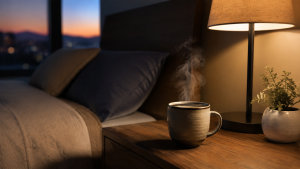
The Quiet Truth About Calm Evenings
A calm evening routine is not about what you do after dinner. It starts the moment you walk through the door, and the first 30 to 60 minutes decide whether the rest of the night feels like rest or like a second shift. The most effective daily routine for a calm evening is built around a deliberate transition - a decompression zone between work mode and home mode.
If you only take one thing from this guide, take this: do not start your routine with a task. Start it with a transition. When I first tried to build a calm evening routine, I made the mistake of starting at 8 p.m., after dinner and dishes. I was already half-asleep on the couch, my brain was still running through email threads, and the 'routine' felt like another obligation. It was not until I moved the start time earlier and created a separate transition space that the rest of the evening changed.
Why the Gap Between Work and Home Is Where Calm Goes to Die
Most people don't realize that the hardest part of an evening routine isn't the routine. It's the moment you cross the threshold. If you go straight from your desk, or from traffic, to making dinner and checking messages, your nervous system never gets the signal that the workday is over.
That gap is where stress peaks. You are no longer in the office, but you are not yet home mentally. The brain is still scanning for unfinished tasks. This is why so many people eat dinner with their shoulders up around their ears.
The solution is not to do more. It is to do less, but with intention. The transitional hour is a buffer. It gives your body a chance to downshift before you ask it to be present with family, cook a meal, or wind down for sleep.
Why Most Evening Routine Advice Feels Too Rigid
Most advice about calm evenings falls into two camps. The first is a list of generic activities: meditate, stretch, read, take a bath. The second is a strict schedule that assumes you have a quiet house and no urgent emails. Both leave out the messy middle.
The messy middle is the 30 to 60 minutes after you walk through the door. That is where the stress of the day is still active. If you do not address it, the rest of your evening is just waiting to be interrupted by your own thoughts.
That is why the transitional hour is not a nice-to-have. It is the foundation. Without it, your formal routine is a series of actions performed while your nervous system is still in work mode.
The Transitional Hour: A 3-Phase Decompression Zone
This is not a rigid schedule. It is a structure you can adapt. The transitional hour has three phases: sensory reset, nervous system shift, and mental close. You can do each phase in as little as 5 minutes, or stretch them to fill a full hour.
Phase 1: The Sensory Reset
Your brain associates your environment with your state. If you sit in the same chair you work from, your brain will keep producing work thoughts. So the first thing you do is change the environment, even if you live in a small apartment.
- Change your clothes immediately. Not into pajamas if that feels too final, but into something that means 'home'. This is the single strongest environmental cue.
- Turn off the overhead light and switch to a low lamp. Light is the strongest cue for your circadian system, and dimming it early tells your body that the day is ending.
- If you use an aromatherapy scent, use the same one every evening. The smell becomes a conditioned cue for calm. Lavender and cedar are common choices, but any scent you only use at night works.
- Open a window for two minutes if you can. Fresh air resets your sense of being inside a work bubble.
When I first tried this, I only changed my shirt and turned off the overhead light. Within a week, the act of switching on the lamp made my shoulders drop. It sounds too simple, but that is exactly why it works.
Phase 2: The Nervous System Shift
After you have changed the environment, you need to change your physiology. Generic meditation is fine, but it can feel like a chore when you are wired. There are faster, more targeted ways to shift your autonomic state.
The physiological sigh is the most effective quick reset I have found. You take two short inhales through your nose, then one long exhale through your mouth. The double inhale inflates the lungs more than usual, and the long exhale activates the parasympathetic nervous system. Do this four or five times.
Box breathing is another option. Inhale for four counts, hold for four, exhale for four, hold for four. Repeat for three to five minutes. The key is not the count, it is the pause. That pause is what signals safety to your nervous system.
Some people find that cold water on the face or wrists helps too. It triggers the dive reflex, which can slow your heart rate. This is not a substitute for medical care, but it is a useful tool when you feel overheated or panicked.
The thing nobody tells you about breathwork: doing it while still in work clothes, in a bright room, is far less effective than doing it after you have already changed your environment. Sequence matters.
Phase 3: The Mental Close
Now that your body is calmer, you can address the racing mind. The problem with 'just don't think about work' is that your brain treats unresolved tasks as open loops. It will keep returning to them until they are written down or assigned a time.
This is where a structured worry time comes in. It is different from vague 'unloading'. You are not journaling about your feelings. You are capturing every open loop and deciding when you will deal with it.
Take a piece of paper and make two columns. On the left, write everything that is still in your head: work tasks, personal errands, things you are worried about. On the right, write the next time you will address each one. It can be 'tomorrow at 9:30' or 'Saturday'. The point is to give your brain a time and place to pick it up again.
This takes about 10 minutes. If you only have 5, just write the list. The act of writing is enough to reduce the cognitive load. One caveat: do not do this in bed. Do it in the living room or at the kitchen table. Your bed should remain associated with sleep, not with planning.
The Science of Racing Thoughts and Why 'Just Relax' Backfires
When you tell yourself to relax, your brain often does the opposite. This is partly because of the Zeigarnik effect, the tendency to remember unfinished tasks more vividly than completed ones. Your brain treats an unresolved work issue like a background tab that keeps using memory.
The answer is not to suppress the thought. It is to give it a place to live outside your head. That is what the mental close does. It converts a vague worry into a concrete next action with a time and place.
If you have ever tried to journal your way out of a stressful evening and ended up writing the same sentence over and over, the problem is that you were processing emotions instead of capturing tasks. Both have a place, but at night, the task capture is what your brain needs first.
The exception is when the worry is not a task but a feeling, like grief or loneliness. In that case, do not try to schedule it. Sit with it for a few minutes, or talk to someone you trust. The mental close is for open loops, not for feelings that need to be felt.
Micro-Rituals to Plug Into Any Phase
If you are not sure what to do during the transitional hour, here are micro-rituals that work well. You can combine them or rotate them.
- The 5-minute tidy: Put away the visible clutter in the room you are in. A clear space reduces visual stress. Do not deep clean, just reset the surfaces.
- The change-of-clothes ritual: This is the first thing you do. It is not about fashion. It is about telling your body that work clothes are off.
- The warm drink: Make a cup of herbal tea or warm water with lemon. The act of holding a warm mug is calming. The routine around the drink matters as much as the tea itself.
- The one-song reset: Play one song you love, without doing anything else. This is a low-effort way to interrupt a stressed thought loop.
- The 1-minute stretch: Reach your arms overhead, roll your shoulders, and bend forward. You do not need a full yoga session.
These micro-rituals are not substitutes for the three phases. They are tools you can use when you only have a few minutes or when a phase feels too heavy.
The 10-Minute Fallback Routine for Chaotic Nights
Life will not always give you a transitional hour. Late meetings, long commutes, kids who need you, or your own low energy will sometimes eat the evening. This is why you need a fallback routine. It is not a lazy version. It is a deliberate triage.
The fallback routine takes 10 minutes and covers the same three phases in compressed form:
- Change clothes and turn off the overhead light. (2 minutes)
- Do the physiological sigh six times. (1 minute)
- Write down the three things that are still on your mind. (3 minutes)
- Do one small, physical comfort action: make a cup of herbal tea, wash your face, or stretch your neck and shoulders. (4 minutes)
If you get home at 9 p.m., skip the formal routine and go straight to this. You will still send the signal to your brain that the day is over. That signal is more important than any specific activity.
For a deeper look at how to sequence these nightly anchors, see our guide to How to Wind Down with a Relaxing Evening Routine. The fallback routine is the minimum viable version of that process.
The Formal Evening Routine That Follows the Transition
Once the transition is done, you have a choice. You can go straight to dinner and rest, or you can continue with a longer evening routine. The transitional hour is the front door. The formal routine is the rooms inside.
If you have the energy, these are the anchors that make a calm evening feel complete.
Anchor 1: Eat and Hydrate
Dinner matters, but not because of any specific diet. The point is to eat without a screen in front of you. When you eat while scrolling, you stay in a state of divided attention. Your digestion and your nervous system both prefer a single focus.
Keep a glass of water on the table. Most people are mildly dehydrated by evening, and that can make irritability worse.
Anchor 2: Move Your Body Slowly
This is not a workout. It is a way to release the physical tension you have been holding all day. Ten minutes of gentle stretching, a short walk around the block, or a few rounds of slow yoga can do more for your sleep than an hour of intense exercise late in the evening.
If you are not sure what to do, start with your neck, shoulders, and hips. Those are the places where stress tends to live.
Anchor 3: Digital Sunset
Set a time after which you do not open email, news apps, or social media. This is not about blue light, it is about cognitive activation. A single stressful headline can undo an entire evening of calm.
If you need a screen, use an e-reader with the warm light setting on. The content matters more than the device. A novel is better than a news feed.
Anchor 4: Read or Listen
Audiobooks and podcasts can be part of a calm routine, but choose them with care. A true crime podcast is not the same as a gentle essay. Save anything exciting for the morning. Evening listening should be low-stakes.
Reading a physical book is still the most reliable way to drift off, because it is linear and unstimulating.
Anchor 5: Sleep Hygiene
Your room should be cool, dark, and quiet. A temperature around 65-68 degrees Fahrenheit is what many sleep specialists suggest. If you cannot control the thermostat, use a fan and a lighter blanket.
This is also the time to wash your face and do any skincare. The ritual of washing your face is less about the products and more about the signal it sends: the day is officially over.
What to Do When You Are Too Wired to Even Start
Some nights are so intense that even the fallback routine feels like too much. You get home, you want to collapse, but your mind is still running at full speed. This is exactly when the transitional hour is most useful, but also hardest to begin.
Here is a trick that works: start with only the first 30 seconds. Do not think about the full routine. Just change your shirt, or turn off one light, or sit down and do one physiological sigh. That is it. If you want to stop after that, stop. More often than not, once you have started, the resistance drops.
The reason this works is that the brain is not really resisting the routine. It is resisting the idea of another task. By lowering the barrier to a single small action, you bypass that resistance.
Another option is to do the routine in a different order. If you are too physically tense to sit still, start with the stretch before the breathwork. If your mind is too loud to focus on breathing, start with the mental close and write everything down. The order is a suggestion, not a law. If you have a high-stress job, your first few attempts at a transitional hour will feel fake. That is normal. The nervous system needs repetition before it trusts the new cue.
How to Handle the Exceptions: Late Work, Kids, and Unexpected Events
Every routine fails if it cannot survive a disrupted evening. The key is to have a decision rule before you need it.
My rule is simple: if I get home less than two hours before I need to be asleep, I use the fallback routine and skip the formal one. I do not try to catch up. I do not tell myself I will do tomorrow's routine twice. I just protect the transition.
If you have kids, the transition often has to wait until after they are in bed. That is fine. You can do a compressed version as you do the dishes or fold laundry. Change your own clothes early, even if you are still on duty. That one action helps you feel less like an employee and more like a parent.
Unexpected events will happen. A phone call from a friend in crisis, a work emergency, a loud neighbor. The routine is not a fortress. It is a practice. You miss a night, you start again the next day. The goal is consistency over time, not perfection on any given evening.
A Simple Decision Matrix for Your Evening Routine
If you are not sure which version of the routine to use, this matrix will help.
| Your situation | What to do |
|---|---|
| You got home on time and feel okay | Full transitional hour, then optional formal routine |
| You got home on time but feel drained | Full transition, skip the formal routine |
| You got home late but not exhausted | 10-minute fallback, then dinner and bed |
| You got home late and exhausted | 10-minute fallback in bed, if needed |
| You are a parent on duty until 9 p.m. | Change clothes early, do the mental close after kids are down |
This matrix is not meant to be perfect. It is meant to remove the decision fatigue that comes from asking 'what should I do tonight?' every single night.
How to Set a Start Time That Actually Holds
Many people set a start time like '7:30 p.m.' and then fail because the clock time changes depending on when they get home. A more reliable approach is to anchor the start time to an event that happens every day.
For example, the routine starts when you change your clothes. Or when you pour your evening tea. Or when you turn on the lamp. The event is the cue, not the clock. This is especially important for people with unpredictable work schedules.
If you do want to use a clock, set an alarm on your phone. But treat the alarm as a cue to start the sensory reset, not as a signal to suddenly feel calm. Calm comes after the reset, not before it.
Common Misconceptions About Evening Routines
There are three myths that keep people from building a routine that works.
Myth 1: You need to be consistent every single night. Consistency is important, but not in the way people think. A routine that you follow three nights a week for a year is more effective than a routine you follow seven nights a week for two weeks. The breaks are part of the practice.
Myth 2: A calm evening starts with a fixed bedtime. A bedtime is useful, but the transition is more important. You can have a perfect bedtime and still lie awake because you never shifted out of work mode. The transition is the bridge to the bedtime.
Myth 3: You need to be in a good mood to do the routine. Actually, a calm evening routine is for the nights when you are not in a good mood. That is when it does the most work. If you only use it on good nights, you are only using the easy version.
What Actually Makes a Routine Stick
After a year of experimenting with calm evening routines, I can tell you what I wish someone had told me at the beginning.
The first thing is that you will skip nights. You will fall asleep on the couch. You will eat dinner in front of your phone. That is not failure. The routine only becomes a routine when you come back to it, not when you never miss it.
The second thing is that the transition matters more than the activity. A 10-minute fallback routine done in the right order is more effective than an hour of meditation done in a bright room with your phone next to you.
The third thing is that you cannot expect a calm evening to undo a chaotic day. It can buffer it, but it cannot erase it. If your days are consistently overwhelming, the answer is not a better evening routine. It is changing your workload, your boundaries, or your commitments. As we discussed in our guide to a Simple Daily Routine to Boost Your Mood, the habits that help you feel good are the ones that are honest about what you can sustain.
A Final Word on Calm Evenings
A daily routine for a calm evening is not about being productive with your rest. It is about giving your nervous system a clear signal that the day has ended. The transitional hour does that better than any checklist.
Start tonight. You do not need to fix your whole evening at once. Pick one phase of the transition, the sensory reset, the breathwork, or the mental close, and do it for three nights. See what changes. Then add the next phase.
The calm you are looking for is not in the perfect routine. It is in the moment you let the day go.