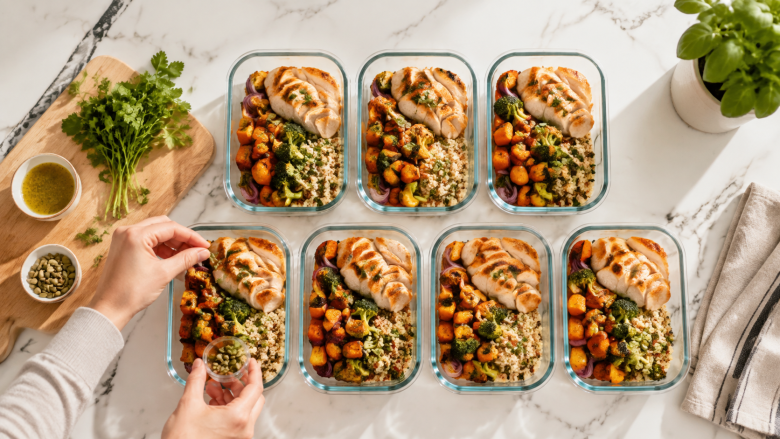
The core idea: mealtimes are your day's infrastructure, not just fuel stops
If you want to build a routine around meal times that actually survives real life, stop thinking of meals as isolated events and start treating them as the structural anchors of your entire day. The goal is not to eat at the same clock time every day - it is to create a predictable sequence of cues and behaviors that your brain can latch onto, regardless of whether you work nights, travel often, or have a freelance schedule that changes weekly.
In the first 150 words, here is the answer: you build a mealtime routine by choosing one consistent behavioral anchor (like always eating within 90 minutes of waking), then stacking two or three smaller habits onto that anchor, and finally building in explicit flexibility rules for when your schedule deviates. This works because mealtimes are the most biologically grounded events you control - hunger hormones, energy dips, and social rhythms all cluster around eating. When you use meals as anchors, you give your executive function a scaffolding that reduces decision fatigue and actually structures your focus for the rest of the day.
Most advice on mealtime routines is either too rigid (eat every day at noon, no exceptions) or too loose (just listen to your body). Both fail for anyone with irregular hours. What you need is a system that expects disruption and has a default response for it. That is what I will walk you through.
Why mealtimes make the best anchors for adult executive function
I spent years working as a night-shift ER nurse, then transitioned to remote freelance writing. Both schedules destroyed my ability to keep a consistent routine because I was trying to eat at "normal" times that my body never agreed with. The turning point came when I stopped forcing a clock-based schedule and started using meals as anchors for my circadian and behavioral rhythms.
Here is what I learned: your brain does not care about the numbers on a clock. It cares about sequence and predictability. When you eat, your body releases insulin, ghrelin, and other hormones that influence alertness and fatigue. If you eat at erratic intervals, your energy levels become erratic. But if you attach meals to a consistent behavioral cue - like "first meal after waking" or "last meal before starting work" - your body learns to expect nourishment at those transition points, which stabilizes your energy and mood.
The psychology behind this is called habit bundling, a term from behavioral science. You link a new behavior to an existing cue. Mealtimes are perfect cues because they are already wired into your brain - you get hungry, you eat. But you can deliberately design the cue to be something else: finishing your morning commute, finishing your first deep-work block, or even brushing your teeth. The point is that the meal becomes the reward and the trigger for other actions.
Most people don't realize that a mealtime routine is not about the food - it is about creating a series of transition rituals that tell your brain "now we shift into a different mode." That is why you can use breakfast to signal the start of your workday, lunch to signal a mental break, and dinner to signal the end of work. When you do this consistently, you reduce the cognitive cost of switching tasks, which is one of the biggest drains on productivity and willpower.
Designing your cue-to-routine chain: the habit-stacking framework
The most reliable way to build a mealtime routine is to use the habit-stacking formula: After [existing habit], I will [new behavior]. But you need to choose the right existing habit. It should be something you already do without fail, like waking up, brushing your teeth, or sitting at your desk. Then you attach a meal-related action to it.
Here is the exact process I use with clients (and myself):
- Identify your non-negotiable daily anchors. These are things you do every single day regardless of schedule: waking up, taking a shower, turning on your computer, commuting, or even checking your phone. Write down the top five.
- Decide which meal goes with which anchor. For most people, breakfast goes with waking up. But if you practice intermittent fasting, your first meal might go with "after my morning walk" or "when I log into my first meeting." You are not bound by clock time - you are bound by sequence.
- Stack one small habit onto each meal. For example, after you pour your coffee, you write down your top three tasks for the day. After you finish your lunch, you take a 5-minute walk. After you eat dinner, you do a 10-minute stretch. These small habits become the "bookends" that make the meal a true anchor.
I remember when I first tried this, I made the mistake of trying to stack too many habits at once. I wanted to meditate, journal, and plan my day at breakfast. It lasted three days. The fix was to start with just one tiny habit per meal. For breakfast, I only wrote down my top three tasks - and I used a 3x5 card, not a phone app, because the physical act of writing was more satisfying. That single habit took two weeks to stick, but once it did, adding a second habit was easy.
The thing nobody tells you about habit stacking around meals is that you need to design for failure. If you miss breakfast because you slept in, what is your fallback? I set a rule: if I miss my morning anchor, I do the same routine whenever I first eat, even if it is 2 PM. The sequence matters more than the time. That way, your brain still gets the "start of day" signal, and you do not lose the whole day to a scheduling slip.
Building flexibility into your rhythm for irregular schedules
If you work shifts, travel frequently, or have a freelance schedule with unpredictable deadlines, a rigid mealtime routine will collapse within a week. You need a system that is adaptable by design. Here is how to do that without losing the benefits of a routine.
The 3-2-1 rule for flexible anchoring
I developed this rule after coaching several nurses and new parents. It works like this:
- 3 meals you try to keep as fixed anchors (breakfast, lunch, dinner) but with a window of 2 hours each, not a specific minute.
- 2 meals you allow to be flexible - you can shift them up to 4 hours, or skip them if you are doing time-restricted eating.
- 1 meal you treat as a complete wildcard - it can happen whenever, or not at all, depending on the day.
For a night-shift worker, the "wildcard" meal is usually breakfast (or whatever you eat when you get home). For a remote worker with back-to-back meetings, lunch is often the wildcard. The key is to decide in advance which meal is which, so you do not have to make a decision when you are tired and hungry.
Another technique is to use time-blocked windows instead of fixed times. For example, you decide that your first meal will happen between 8 AM and 10 AM, your second between 1 PM and 3 PM, and your third between 7 PM and 9 PM. You do not care exactly when within those windows - you just make sure you do not let them slide more than that. This gives you the flexibility to handle a late meeting while still protecting the overall rhythm.
When I was working night shifts, my "lunch" was at 2 AM. I used the same cue-to-routine chain: after I finished my charting, I ate, then I did a quick breathing exercise. It felt weird at first, but within two weeks my body adapted, and I no longer felt hungry at odd hours. The flexibility was not about eating at "normal" times - it was about being consistent with the sequence of events in my own day.
Travel and unusual eating environments
When you travel, your mealtime anchors are the first thing to go. But you can keep the routine alive by focusing on the anchor behavior rather than the meal itself. For example, if your anchor is "after I eat, I do a 5-minute walk," you can still do that in a hotel room or at an airport. If your anchor is "before dinner, I do a 10-minute stretch," you can do that in a hotel room or at an airport. The food changes, but the behavioral chain stays.
I also recommend carrying a small kit of "anchor reminders" when you travel: a favorite tea bag, a small notebook, or a specific playlist. These objects trigger the same neural associations as your home environment, making it easier to re-establish the routine after a trip. This is a trick I learned from a colleague who does long-haul flights - he always eats the same snack on the plane to signal to his body that the meal anchor is coming, even if the clock says something else.
Managing motivation drift: what to do when your routine falls apart
Every routine eventually hits a wall. You get sick, you go on vacation, a project deadline consumes you, or you just lose the will to care. The difference between people who keep a routine and those who don't is not willpower - it is having a defined recovery protocol.
I call this the 5-day reset. When you notice your mealtime routine has completely disintegrated, you do not try to fix everything at once. Instead, you commit to just five days of rebuilding one anchor meal. Pick the meal that used to be your strongest anchor - for me, it is breakfast. For you, it might be dinner. For five days, you only focus on that one meal. You eat it at roughly the same time, you perform the same small habit around it, and you ignore all other meals. After five days, you add the second anchor. This gradual approach works because it lowers the barrier to re-entry - you are not facing the impossible task of rebuilding your entire day.
What about motivation drift during a single day? That happens when you are mid-afternoon, you feel tired, and you start thinking "I'll just skip lunch and work through." That is a classic trap. When you skip a meal, you actually reduce your cognitive performance, and you are more likely to make impulsive decisions later. The fix is to pre-commit to a minimum viable meal - something you can eat in 5 minutes even when you are buried in work. For me, that is a protein shake and a banana. For you, it might be a yogurt cup and a handful of nuts. The point is to not let the anchor break completely. A tiny meal still triggers the behavioral sequence, and you can always have a bigger snack later.
One of the most honest limitations of any mealtime routine is that it will not fix deeper issues like chronic stress or disordered eating. If you are using mealtime routines as a way to control anxiety, or if you find yourself obsessing over eating times, that is a sign to seek professional support. A routine is a tool, not a therapy. I am not a medical professional, and I encourage you to consult with a registered dietitian or therapist if you have a complicated relationship with food.
Practical implementation: a step-by-step process to start tomorrow
Here is a concrete plan you can put into action starting tomorrow morning. It takes about 20 minutes to set up, and you will start seeing benefits within a week.
Step 1: Map your current day
Take a piece of paper and write down every recurring event in your day that is not a meal: waking up, showering, checking email, starting work, picking up kids, walking the dog, etc. Circle the three that happen most consistently, regardless of time. These will be your primary anchors.
Step 2: Choose your anchor meals
Decide which meal you will attach to each of those three events. It does not have to be breakfast, lunch, and dinner in the traditional sense. It could be "first meal after waking," "meal before my afternoon meeting," and "meal after I get home." Write them down.
Step 3: Add one tiny habit to each anchor
For each meal, choose one small behavior that takes under 2 minutes. Examples:
- Drink a full glass of water before eating.
- Write down one thing you are grateful for.
- Text a friend or family member.
- Do 10 deep breaths.
- Set a timer for 5 minutes and eat without screens.
Do not choose a habit that requires a lot of effort or equipment. The simpler, the better.
Step 4: Build your flexibility rules
Write down what you will do if you miss a meal due to a meeting, travel, or emergency. For example: "If I miss breakfast, I will eat within 2 hours of waking and still do my gratitude journal." Or "If I miss lunch, I will have a protein shake and then do my walk during my next break." Having these rules written down means you do not have to think when you are in a panic.
Step 5: Track for one week
Use a simple checklist (paper or a habit app) to mark off each day you successfully executed the anchor meal and its stacked habit. Do not aim for 100% - aim for 80%. If you hit 6 out of 7 days, that is a win. If you hit 4 out of 7, adjust your flexibility rules or simplify your habit.
After the first week, review what worked and what failed. You might discover that your chosen anchor event (like "checking email") is too variable because you check email at random times. In that case, switch to a more reliable anchor like "after brushing my teeth" or "after I open my laptop."
Common pitfalls and how to fix them
Pitfall 1: You try to change too many things at once
As I mentioned earlier, stacking three new habits onto three meals is a recipe for burnout. Fix: start with just one meal and one habit. Master that for two weeks before adding a second.
Pitfall 2: You ignore your body's natural hunger signals
Some people get so obsessed with the routine that they force themselves to eat when they are not hungry, just because the clock says it's time. That is not a routine - that is a cage. Fix: allow a 2-hour window, and if you truly are not hungry within that window, skip the meal and move your next meal earlier. The routine is about sequence, not force.
Pitfall 3: You use your phone during meals
If you eat while scrolling, your brain does not register the meal as a distinct event. That weakens the anchor effect. Fix: make the rule that you eat at a table or a designated spot, and put your phone in another room. If you absolutely need to check something, do it before or after the meal, not during.
Pitfall 4: You let a single missed meal spiral into a missed day
This is the most common reason routines die. You oversleep, skip breakfast, and then think "well, I already messed up, so I might as well eat junk for lunch and skip dinner." Fix: have a "reset phrase" that you say to yourself, like "One missed anchor does not sink the day." Then immediately re-engage with your next anchor meal, even if it's 3 hours late.
Pitfall 5: You do not account for social and family commitments
If you live with others, your mealtime routine affects them too. Fix: communicate your anchor windows to your family or roommates. Ask them to respect those times, but also be willing to flex if there is a special occasion. The goal is not to be inflexible - it is to be intentional.
The psychological payoff: how mealtime anchors restructure your focus
Once you have a mealtime anchor routine in place for a few weeks, you will notice something subtle but profound: your day starts to feel less chaotic. Because you have predictable transition points, your brain can let go of the need to constantly monitor "what's next." You know that after breakfast, you will start work. After lunch, you will take a walk. After dinner, you will stretch. This predictability reduces the cognitive load of decision-making, freeing up mental energy for the tasks that actually matter.
I have seen this in my own life. When I was working nights, my mealtime anchors were the only constants in a sea of chaos. They gave me a sense of control that I desperately needed. And when I transitioned to freelance work, those same anchors helped me maintain a sense of normalcy even on days when I had three different deadlines.
This is why mealtime routines are not just about nutrition - they are about executive function. They act as a temporal anchor that structures your perception of time. If you have ever had a day where you look up at 6 PM and realize you have not eaten and you feel like you lost the day, that is a sign that you lack anchors. A mealtime routine fixes that.
Advanced considerations for special populations
If you are a shift worker, a new parent, or someone with a chronic illness, you need to adapt these principles further. Here is what I have learned from working with clients in these situations:
Shift workers
Your circadian rhythm is constantly shifting, so you need to anchor to your own sleep-wake cycle, not the sun. Use your "wake-up meal" as the anchor, regardless of whether it is 6 AM or 6 PM. Do not try to eat at the same clock time as your day-shift colleagues. Also, be extra careful about caffeine timing - avoid caffeine within 6 hours of your planned sleep time, even if your meal anchor falls in that window.
New parents
Your schedule is controlled by a tiny human, so you need to be even more flexible. The 3-2-1 rule still works, but your wildcard meal is likely to be dinner. Use the "minimum viable meal" strategy for meals you eat while holding a baby. And do not beat yourself up if you eat cold pasta over the sink - the anchor is the act, not the presentation.
People with digestive issues
If you have GERD, IBS, or other conditions, mealtime routines can actually help manage symptoms because your body learns to expect food at certain times, reducing acid surges or bloating. But you need to work with a healthcare provider to determine the right spacing and portion sizes. Do not use a rigid routine to ignore pain - if a meal consistently causes discomfort, that is a medical issue, not a scheduling issue.
Putting it all together: your adaptable mealtime anchor plan
Here is a summary of the entire method in one table, so you can print it out and stick it on your fridge:
| Component | What to do | Example |
|---|---|---|
| Primary anchors | Choose 3 consistent events in your day | Waking up, starting work, finishing work |
| Anchor meals | Attach a meal to each event | Breakfast, lunch, dinner |
| Stacked habits | Add 1 tiny habit per meal | Drink water, write gratitude, stretch |
| Flexibility windows | Allow 2-hour windows for each meal | 8-10 AM, 1-3 PM, 7-9 PM |
| Wildcard meal | Pick 1 meal that can shift or be skipped | Snack or late-night meal |
| Recovery protocol | 5-day reset focusing on one anchor | Rebuild breakfast first |
If you want to deepen your habit practice, I recommend pairing your mealtime routine with other daily anchors. For example, our guide on starting a morning walk routine works beautifully with a breakfast anchor - you can stack your walk right after breakfast. Similarly, the 10-minute daily stretch habit can be your post-dinner anchor. These small combinations create a web of routines that reinforce each other.
And if you are struggling to figure out what to eat for those anchor meals, our balanced meal plan for weekday evenings can give you structure without adding decision fatigue.
The most important thing to remember is that a routine is a living system, not a set of rules. It will bend, break, and need repair. That is okay. The goal is not perfection - it is consistency over time. You are building a relationship with your own body and your own day. Treat that relationship with the same kindness and flexibility you would offer a good friend.
Start tomorrow. Pick one meal. Pick one tiny habit. And let that anchor hold. You will be surprised at how much stability it brings to the rest of your day.