The Short Answer: Yes, But Not for the Reason You Think
Most people buy a massage gun to fix a tight hamstring or a knot in their shoulder. But the real magic happens when you stop treating it as a muscle recovery tool and start using it as a nervous system reset. I've spent the last six years working with clients who struggle with chronic stress, and I've seen a massage gun do more for their anxiety than any foam roller ever could. Here's the honest truth: a massage gun relieves stress by activating your parasympathetic nervous system, lowering cortisol, and giving your brain a sensory break from its own chatter. In this guide, I'll show you the exact protocol I use with my clients - a 5-minute ritual that targets the stress hotspots most people ignore.
If you're expecting just a list of attachment heads and speeds, you'll get that too. But the real value is in the why and the how. So let's start with the science, because once you understand the mechanism, you'll never use a massage gun the same way again.
The Mind-Body Connection: Why Vibration Calms Your Nervous System
Stress isn't just a feeling in your head. It's a full-body event. When you perceive a threat - a deadline, an argument, a never-ending to-do list - your sympathetic nervous system (the 'fight or flight' branch) ramps up. Your heart rate increases, your breathing becomes shallow, and your muscles tense up, especially in the neck, jaw, and shoulders. This is your body preparing to run from a tiger, except the tiger is an email.
Here's what most articles miss: that muscle tension isn't just a symptom of stress - it's a feedback loop. Tense muscles send signals back to your brain that say 'danger is still here,' which keeps cortisol elevated. So even if you cognitively know you're safe, your body doesn't get the memo. That's where a massage gun comes in. The rapid, percussive vibrations activate mechanoreceptors in your skin and muscle tissue. According to a study published in the Journal of Clinical Medicine, percussive therapy can reduce cortisol and increase oxytocin - the bonding and calm hormone. But the more interesting effect is on the vagus nerve.
The Vagus Nerve: Your Body's Brake Pedal
The vagus nerve is the main highway of your parasympathetic nervous system. When it's stimulated, your heart rate slows, blood pressure drops, and your body shifts into 'rest and digest' mode. Vibration - especially low-frequency, rhythmic vibration - has been shown to activate vagal tone. A review in Frontiers in Neuroscience found that whole-body vibration can improve heart rate variability (HRV), which is a direct measure of how well your nervous system can flex between stress and calm.
But here's the thing nobody tells you: the location matters. You can't just slap the massage gun on your quad and expect a stress reset. The vagus nerve has branches that run through your neck, throat, and jaw. That's why the protocol I'll share later focuses on the suboccipital area, the upper traps, and the masseter (jaw) muscle. These are the spots where tension physically grips you - and where vibration has the most direct line to your nervous system.
What I Learned From My First Mistake
When I first started using a massage gun for stress, I made the classic error: I turned it up to maximum speed and went straight for the neck. Big mistake. Within 30 seconds, I felt dizzy and nauseous. The neck and throat are delicate areas with sensitive nerves and blood vessels. Overstimulating them can trigger a vasovagal response - the opposite of what you want. I learned the hard way that stress relief with a massage gun requires a light touch, a slow speed, and a deliberate breathing pattern.
That experience taught me to treat the massage gun not as a power tool but as a precision instrument for nervous system regulation. The difference between a muscle recovery session and a stress relief session is like the difference between a heavy weightlifting session and a yoga class. Both are physical, but one is about loading and the other about releasing. For stress, you're not trying to break up adhesions - you're sending a signal to your brain that it's safe to stop clenching.
The 5-Minute Stress Relief Protocol
This protocol is designed for anyone who's had a rough day, feels tight in the neck and shoulders, or just wants to downshift before bed. You'll need a massage gun with at least three speed settings and a rounded or flat attachment. Avoid the pointed bullet attachment for this - it's too intense for the areas we're targeting. Set your device to the lowest speed (around 1200-1500 percussions per minute). If you don't know your device's exact RPM, use the 'low' or 'gentle' preset.
Before you start, set a timer for five minutes. You'll spend about 75 seconds on each of four zones. The key is to pair each zone with a specific breathing pattern. Inhale for four counts, exhale for six. This extended exhale is what activates your parasympathetic nervous system. If you're not used to breath counting, just focus on making your exhale longer than your inhale.
Zone 1: Suboccipital (Back of the Skull)
Start with the suboccipital muscles - the small muscles that connect your skull to your first two vertebrae. They're the ones that get tight from looking at screens all day. Gently place the massage gun on the base of your skull, just above the hollow where your neck meets your head. Keep the pressure light - barely enough to feel the vibration. Move the gun in slow circles for 60-75 seconds. You should feel a wave of relaxation spreading down your neck. If you feel any sharp pain or dizziness, stop immediately and move to the next zone.
Most people don't realize that the suboccipital area is packed with nerve endings and is a major trigger point for tension headaches. A 2019 study in the Journal of Bodywork and Movement Therapies found that suboccipital inhibition reduced headache frequency and intensity. By gently vibrating this area, you're not just releasing muscle tension - you're calming the entire trigeminocervical complex, which is directly linked to the brain's stress centers.
Zone 2: Upper Traps (Shoulder Tops)
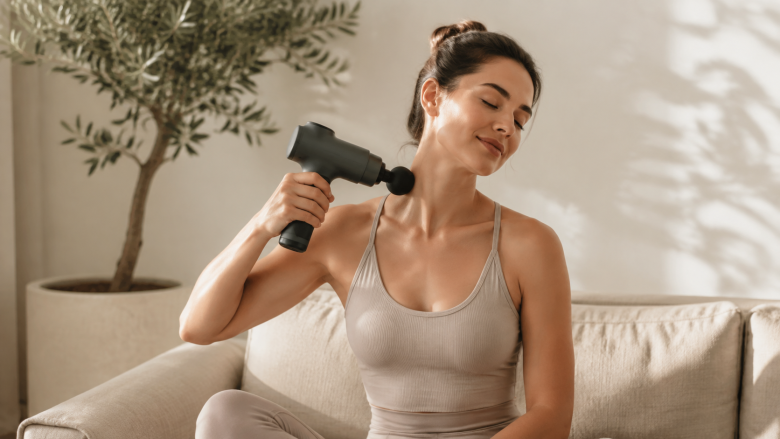
After the suboccipital, move to the upper trapezius muscles - the band of muscle that runs from your neck to your shoulder. This is where most people carry their stress. Place the gun on the middle of the shoulder muscle, not directly on the spine. Use a flat attachment and keep the speed low. Glide slowly from the base of your neck outward to the acromion (the bony bump on your shoulder). Repeat on the other side. Spend about 75 seconds total, alternating sides every 15 seconds.
A common mistake here is pressing too hard. The upper traps are often already hypertonic, and aggressive pressure can trigger a protective spasm. Instead, think of the massage gun as a gentle hum, not a jackhammer. You want the vibration to feel like a deep, calming buzz - not a painful pounding. As you move, keep your breathing slow. With each exhale, imagine the muscle melting under the gun.
Zone 3: Jaw and Temples
This is the zone that most massage gun guides completely overlook. Your jaw - specifically the masseter muscle - is a major stress hotspot. Clenching your jaw during the day or grinding your teeth at night keeps this muscle in a constant state of tension. To reach it, use a rounded or ball attachment. Place the gun on your cheek just in front of your earlobe, where you feel the muscle when you clench your teeth. Keep the speed on the absolute lowest setting - this area is very sensitive. Glide gently in small circles for 30-45 seconds on each side. Then, move to your temples using the same attachment, but even lighter pressure. The temples are thin, and the temporal artery runs right beneath the skin. Do not linger here for more than 15 seconds per side.
The first time I tried this, it felt bizarre. But within a few sessions, I noticed my jaw unclenching naturally throughout the day. The vibration seems to interrupt the subconscious clenching pattern. It's not a permanent fix, but it's a powerful reset that gives you a moment of awareness. If you have a history of TMJ disorders, consult your dentist or physical therapist before using a massage gun on your jaw. In some cases, the vibration can exacerbate inflammation.
Zone 4: Forehead and Scalp (Optional)
If you still have time left in your five minutes, finish with a light pass over your forehead and scalp. This is more about mindfulness than muscle release. Use a flat attachment and the lowest speed. Glide from your eyebrows upward to your hairline, then back down. Keep the pressure feather-light - you're just stimulating the nerve endings that are linked to relaxation. This can feel incredibly soothing, especially after a long day of mental work. Some people report a tingling sensation that travels down the back of the neck, which is a sign that your parasympathetic nervous system is engaging.
If you want to extend this into a longer ritual, you can pair it with a guided body scan. As you move the gun to each zone, mentally note any areas of tightness or discomfort. This turns the massage into a mindfulness practice, which amplifies the stress-relieving effects. For more on mindful movement, you might enjoy our guide on mindful walking tips for stress relief - it uses the same principle of linking breath to sensation.
Why This Works: The Science of the Somatic Reset
What you just did in those five minutes is more than a massage - it's a somatic reset. By combining gentle percussion with slow breathing, you're giving your nervous system a new input pattern. Instead of the high-alert signals from tense muscles, you're sending a steady stream of 'safe' signals. The vibration activates Ruffini endings - mechanoreceptors that respond to skin stretch and low-frequency pressure. These receptors are wired to the insula, a brain region that processes body states and emotions. When the insula gets a message of calm, it downregulates the amygdala, which is your fear center.
This is why a massage gun can be more effective for stress than a traditional massage. It's not that a human massage isn't good - it is. But the percussive action is more consistent and more targeted. You can hit those specific stress points that a massage therapist might not focus on, and you can do it anytime, anywhere. The downside is that you might miss the human connection and the broader full-body relaxation that a professional therapist provides. But for a quick, self-directed reset, a massage gun is hard to beat.
Common Mistakes That Keep You Stressed
Even with a good protocol, most people sabotage their stress relief with a few common errors. Here's what I see in my practice and what I've fallen into myself:
- Using high speed and high pressure. For stress relief, you want low speed and light-to-medium pressure. High speed is for deep muscle recovery, not nervous system calming. Think of it like the difference between a sledgehammer and a tuning fork.
- Rushing through the zones. If you spend only 10 seconds on each spot, you're not giving the nervous system time to respond. The parasympathetic response takes at least 30-45 seconds to kick in. That's why the 5-minute protocol has you stay on each zone for over a minute.
- Forgetting to breathe. If you're holding your breath or breathing shallowly while using the gun, you're staying in sympathetic mode. The vibration is just a physical sensation. The breath is what converts it into a psychological signal of safety.
- Treating it as a one-time fix. A single session can make you feel better for an hour, but chronic stress requires regular practice. I recommend using this protocol 2-3 times a week, or whenever you feel a stress spike. Over time, you'll notice that your baseline tension drops - you're not as quick to clench your jaw or hunch your shoulders.
When Not to Use a Massage Gun for Stress
I'm not a doctor, and I won't pretend to be one. But after years of working with clients, I've learned the red flags. Do not use a massage gun on your neck, head, or throat if you have any of the following:
- Carotid artery disease or a history of stroke or aneurysm
- Blood clots or deep vein thrombosis
- Osteoporosis or bone cancer
- Recent surgery or active inflammation in the area
- Pacemaker or other implanted medical device
- Pregnancy (especially avoid the abdomen and lower back)
Even if you're healthy, never use a massage gun on your throat, the front of your neck, or directly on your spine. The throat houses the carotid artery and the vagus nerve - overstimulation can cause a dangerous drop in blood pressure. Also, avoid using it on any area with broken skin, varicose veins, or a recent injury. When in doubt, consult a healthcare professional. The massage gun is a tool, not a miracle device, and your safety always comes first.
If you have a known anxiety disorder or PTSD, a massage gun can be a helpful addition to your toolkit, but it's not a replacement for therapy or medication. I've seen clients use it as a grounding technique during panic attacks - the vibration gives them a physical sensation to focus on, which can pull them out of a spiral. But for that purpose, I'd recommend using it on your hands or feet rather than your neck. The hands and feet are rich in nerve endings and are less risky.
Pairing the Massage Gun with Other Stress-Relief Practices
The 5-minute protocol works on its own, but it becomes even more powerful when you layer it with other mindfulness practices. For example, after my evening session, I often finish with a few minutes of mindful eating if I'm having a snack. That might sound odd, but the same principles apply - slowing down, paying attention to sensation, and breathing. Our article on 5 tips to eat mindfully without stress explains how to turn a meal into a meditation. You can use the massage gun as a pre-eating ritual to shift your nervous system into a relaxed state, which improves digestion and reduces stress-related overeating.
Similarly, you can combine the massage gun with progressive muscle relaxation. After each zone, tense the muscle you just worked on for five seconds, then relax it completely. This increases body awareness and deepens the release. Or use it as part of a bedtime routine - the 5-minute protocol is perfect for winding down. Just make sure you're not using it too close to sleep if the vibration feels stimulating. Some people find it calming, others find it invigorating. You'll know which camp you're in after a few tries.
Choosing the Right Massage Gun for Stress Relief
If you're in the market for a massage gun, don't assume that the most expensive, highest-powered model is the best for stress. In fact, for the protocol I've described, you want a device that has:
- A low-speed setting (ideally below 1500 RPM)
- Interchangeable heads - at least a flat and a rounded ball
- A lightweight design (you'll be holding it near your neck and head, so you don't want arm fatigue)
- Quiet operation (a loud motor can be stressful in itself)
I've used everything from a $50 budget gun to a $400 Theragun. The main difference is build quality and how smoothly the motor runs. For stress relief, you don't need the heavy-duty torque that athletes use. I actually prefer a lighter, quieter model because it feels less aggressive. But if you also want to use it for muscle recovery after workouts, get one with a good range of speeds and a longer battery life.
One thing nobody tells you: the attachment head matters more than the brand. The flat head is best for broad areas like the traps. The round head is better for the jaw and suboccipital. The forked head is useful for the neck, but I find it too intense for stress work. The bullet head is for deep trigger points - avoid it unless you really know what you're doing. I keep two heads in my bag: the flat and the round. That covers 90% of my stress relief needs.
My Honest Take: The Limitations and the Real Benefits
I've been singing the praises of the massage gun for stress, but I want to be clear about its limits. It's not a cure for anxiety or a substitute for therapy, sleep, or exercise. It's a tool that can shift your nervous system in the moment, but the effects are temporary. A 5-minute session might give you a few hours of calm, but if you're chronically stressed, you need to address the root causes - work-life balance, relationships, health habits. The massage gun is a band-aid, albeit a very effective one.
What it does brilliantly is interrupt the stress spiral. When you're in the middle of a stressful day, you often don't realize how tense your body is until you feel it release. The massage gun forces you to slow down and pay attention to your physical state. That awareness alone can be transformative. I've had clients tell me that after using this protocol for a week, they started noticing when they were clenching their jaw during meetings - and could release it before it became a headache. That's the real power: not just the physical vibration, but the mindfulness it creates.
So, yes, you can relieve stress with a massage gun. But only if you approach it with intention, breath, and a willingness to listen to your body. The 5-minute protocol I've shared is a starting point. Adjust it to fit your needs - maybe you need more time on your jaw, or less on your traps. The goal is not to follow a rigid script but to develop a ritual that works for you. Start with this, and you'll quickly learn what your body is asking for.
Final Thoughts: Make It a Ritual, Not a Chore
The best way to use a massage gun for stress is to integrate it into your daily routine. Pick a consistent time - maybe after work, before dinner, or right before bed. Set up a comfortable space with low lighting and maybe some calming music. The environment matters as much as the technique. If you're in a rush and just jabbing the gun at your neck while scrolling through your phone, you won't get the same benefit. Treat it as a mini-meditation.
Finally, remember that the massage gun is just one tool. Pair it with other stress-relief practices like mindful walking or breathing exercises. The more you train your nervous system to downshift, the easier it becomes. Over time, you might find that you don't even need the massage gun as often - your body learns to release tension on its own. But when you need a quick reset, it'll be there.
I hope this guide has given you a new perspective on what a massage gun can do. It's not just for athletes. It's for anyone who carries stress in their body - which is all of us. Try the 5-minute protocol tonight. Your nervous system will thank you.