If your piriformis feels tight, the last thing you want to do is force a deep stretch. Gentle movement - slow, rhythmic, and pain-free - is the first step that most people skip. It tells your nervous system to stop guarding the muscle, which is often the real reason it feels tight. In this guide, you'll get a 5-minute flow you can do anywhere, plus a clear way to tell the difference between muscle tightness and nerve irritation. No equipment. No holding. Just movement.
When I first tried to fix my own piriformis, I made the mistake of pushing into a deep pigeon pose. Within minutes, I had a shooting pain down my leg. Here's what I learned: the piriformis was tight because my nervous system was protecting it. The only way to release it was to move it gently, not pull it.
Why Forcing a Stretch Can Make a Tight Piriformis Worse
Most people treat a tight piriformis like a knot that needs to be yanked open. They hold a deep pigeon pose for a minute, hoping the muscle will finally release. But if the tightness is coming from muscle guarding - a protective reflex where the nervous system keeps the muscle contracted - forcing a stretch can make it worse. The stretch reflex kicks in, and the piriformis contracts even harder to protect the area.
According to a StatPearls review on piriformis syndrome, the condition is often a diagnosis of exclusion, meaning other causes of sciatica need to be ruled out first. That matters because if your pain is actually coming from a herniated disc or spinal stenosis, aggressive stretching of the piriformis won't help and may irritate the nerve further.
Most people don't realize that a tight piriformis is often a symptom, not the root problem. The root can be a stiff sacroiliac joint, a weak glute, or a hip flexor that's too short. Gentle movement works because it desensitizes the nervous system. It says, 'This area is safe to move.' That is the first step before stretching or strengthening.
This doesn't mean stretching is bad. It just means there's an order of operations. Movement first, stretch second. If you skip the movement, you're pulling on a muscle that's still in protective mode.
How to Tell If It's Muscle Tightness or Nerve Irritation
The piriformis sits deep in the buttock, and the sciatic nerve runs right under it - or, in about 15 to 20 percent of people, right through it. That means the same symptom can come from two different places. A dull ache in the buttock is usually muscle. A shooting pain, numbness, or tingling that travels down the back of your leg is more likely nerve irritation.
Here's a simple test I use with clients. Try a gentle contraction of the piriformis: sit on a chair, place your right ankle on your left knee, and press your right knee backward against your hand. If that contraction is painful, it's likely muscle guarding. If it feels neutral, you can proceed with gentle movement. If it causes shooting pain or numbness, avoid stretching the area entirely and see a clinician.
If you have weakness in your foot, loss of bladder or bowel control, or pain that gets worse at night, stop and get medical help. That's beyond the scope of any movement practice.
The reason this distinction matters is simple. Stretching a tight muscle is okay. Stretching an irritated nerve is not. Nerve tissue doesn't respond well to sustained tension. It responds to gliding and movement, but only within a pain-free range.
A Simple Decision Flow: Move, Stretch, or Strengthen?
Before you do anything, run your current symptom through this quick framework. It will save you from making the wrong choice and turning a manageable issue into a flare-up.
| What You Feel | Likely Cause | First Step |
|---|---|---|
| Dull ache in the buttock, worse after sitting | Muscle tightness / guarding | Gentle movement flow |
| Shooting pain, numbness, or tingling down the leg | Nerve irritation | Avoid stretching; see a clinician |
| Sharp pain with any hip movement | Possible joint or disc issue | Stop and get evaluated |
| Mild soreness after moving | Normal adaptation | Continue with smaller range |
This framework is not a diagnosis. It's a way to avoid the most common mistake: stretching a nerve that's already angry. If you're unsure, err on the side of gentler movement and less range.
The 5-Minute Gentle Movement Sequence
This sequence is designed to be done on a mat, a carpet, or a firm bed. No equipment. No holding. Each movement is slow, continuous, and paired with breath. The goal is to keep the hip moving through a comfortable range without ever pushing into pain. If any movement feels sharp or electric, skip it and try the modification.
Use your breath as a guide. Inhale to prepare, exhale as you move. Count to four on each breath. If you can't keep a steady breath, the movement is too big.
1. Supine Knee Rocks (2 minutes)
Lie on your back with both knees bent and feet flat on the floor. Let your knees fall slowly to the right, exhaling as they go. Inhale back to center, then fall to the left. Keep the motion small - about 10 to 20 percent of your available range. The goal is to move the pelvis and hip joint, not to pull the piriformis into a stretch.
If you're in an acute flare-up, reduce the range even further. Think of a few inches of motion, not a full fall to the side. You can also place a pillow between your knees for support. Your breath should stay steady; if you're holding your breath, you're doing too much.
When I first taught this move, I saw people trying to make it bigger. They thought more range meant more benefit. It doesn't. The piriformis responds to gentle, repeated motion, not to how far you can go.
2. Happy Baby Sways (1 minute)
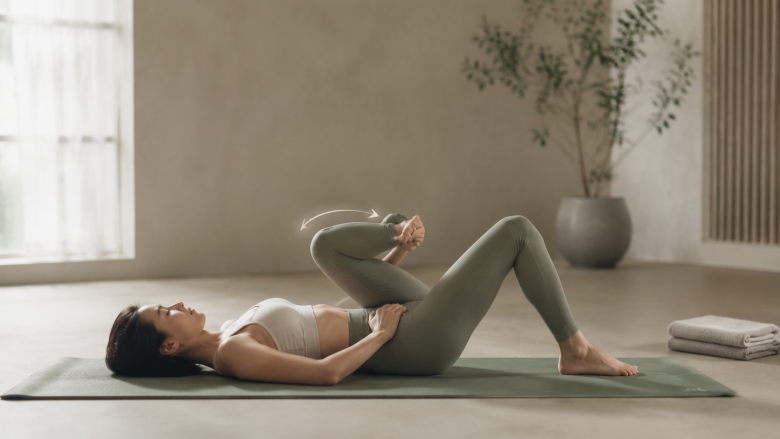
Lie on your back and bring your knees toward your chest. Hold the outer edges of your feet with your hands. Instead of pulling your knees toward your armpits, let them gently sway side to side, like a cradle rocking. This movement takes the hip joint through a comfortable arc without compressing the sciatic nerve. Keep your lower back relaxed on the floor.
If reaching for your feet is uncomfortable, hold the back of your thighs instead. The motion should feel like a slow dance, not a stretch. If your knees drift too far apart, that's fine - let the movement stay easy.
One thing nobody tells you: happy baby is usually taught as a static stretch. But when you add movement, it becomes something different. It's no longer about pulling the hips open. It's about letting the joint sway while the nervous system stays calm.
3. Seated Swaying (1 minute)
Sit on a sturdy chair with your feet flat and hip-width apart. Let your upper body sway gently to the right, shifting weight onto your right sit bone. Come back to center, then sway to the left. This is a subtle pelvic rock that keeps the hip socket mobile without direct pressure on the piriformis. It's especially useful if lying down aggravates your symptoms.
Keep your shoulders relaxed and let the movement start from your pelvis, not your waist. Imagine you are gently polishing the chair with your sit bones. If you need more support, place your hands on your thighs.
This move is a lifesaver for people who spend long hours at a desk. It can be done right in your office chair, no one even notices. I've used it during long flights, and it helps more than any 'airport stretch' I've tried.
4. Standing Hip Circles (1 minute)
Stand next to a wall or a sturdy counter and rest your hand on it for balance. Let your right leg hang loose. Draw small circles with your knee - clockwise for a few breaths, then counterclockwise. Keep the circles small, about the size of a quarter. This moves the hip joint without engaging the piriformis aggressively. Switch legs after about 30 seconds.
If standing makes your symptoms worse, skip this one and return to the supine knee rocks. The idea is to find the most comfortable position and stay there. You can also do this seated if you prefer.
When you draw the circles, don't hold tension in your hip. Let the leg feel heavy and floppy. The less you control it with your muscles, the more the joint can move freely.
How to Move Through a Flare-Up: When to Stop and When to Continue
A flare-up is not the time to 'push through.' If movement causes sharp pain, stop. But gentle movement can actually reduce pain if it's rhythmic and within your comfort zone. The distinction is between pain that radiates and pain that is just 'awareness.' Use a 0 to 10 scale. Keep the movement at 2 or below. If it goes above 3, back off.
In an acute flare-up, do only the supine knee rocks, and reduce the range even further. You can also try the seated swaying if lying down is uncomfortable. The goal is not to fix anything in that moment. It's to let the nervous system know the area is safe enough to move.
It's normal to feel a little sore the next day, especially if you've been guarding the muscle for weeks. But if you feel a burning sensation during the movement, stop. Burning is a nerve sign, not a muscle sign.
I remember one client who insisted on doing the full flow during a severe flare-up. She ended up limping for two days. The next time, she started with just the knee rocks, lying on a pillow, and she was able to walk without pain within 30 minutes. The difference was respecting the flare-up instead of fighting it.
What to Do After the Flow: From Gentle Movement to Stretching and Strengthening
Once the muscle stops guarding, you can progress to static stretching and strengthening. But not before. I usually tell people to do this flow daily for at least five days before attempting any static stretch. When you do stretch, keep it gentle - 20 seconds, no bouncing, no pain. The piriformis responds better to low-load, long-duration stretching than to aggressive pulling.
If your tightness is related to sitting at a desk all day, the gentle stretches for desk workers on this site are a natural next step. And if you want to build a broader habit, the daily 20-minute movement routine pairs well with this flow - it keeps the whole body moving, not just the hip.
Eventually, you'll want to add strengthening exercises like clamshells, side planks, or glute bridges. But strength work comes last. If you strengthen a muscle that's still in protective mode, you're just reinforcing the guarding pattern.
Here's a progression I use with clients:
- Week 1: Gentle movement flow every day. No stretching.
- Week 2: Add 2 to 3 static stretches, held for 20 seconds each, only if pain-free.
- Week 3: Add light strengthening, like clamshells with a resistance band, 2 to 3 times per week.
- Week 4: Reassess. If pain persists, consider seeing a physical therapist or getting imaging.
This timeline isn't rigid. Some people need a full month of gentle movement before they can tolerate stretching. That's okay. The piriformis doesn't care about your schedule.
What Nobody Tells You About a Tight Piriformis
Most people don't realize that the piriformis is rarely the sole culprit. It's often reacting to a stiff sacroiliac joint, a weak glute, or a hip flexor that's too short. Gentle movement helps, but if you're only moving the piriformis, you might miss the bigger picture. That's why this flow includes pelvic movements, not just isolated hip movements.
The thing nobody tells you about gentle movement is that it's boring. It doesn't feel effective. It's easy to think you should be doing more. But the nervous system responds to safety, not intensity. When I first tried this approach on myself, I was skeptical. After a week of daily knee rocks, my hip felt different - not 'loose,' but less guarded. The shooting pain was gone. That was enough to convince me.
Still, this isn't a cure-all. If your piriformis tightness is due to a structural issue like a leg length discrepancy or hip arthritis, you'll need professional help. I've seen people do this flow for a month and still have pain. That's when you get imaging or see a physical therapist. Gentle movement is a first step, not a final answer.
One more thing: don't do this once and expect a miracle. The piriformis responds to consistency. Five minutes a day is better than thirty minutes once a week. If you can, tuck the flow into your morning routine or use it as a break from sitting. Your hip will thank you.